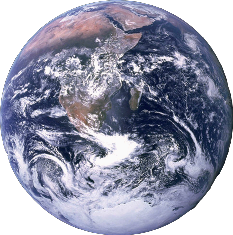
 Three spheres....
This diagram is split into three sections: the subterranean, the biosphere and the atmosphere. At this stage in the explanation, we can ignore the subterranean but we will return to it. The atmosphere extends 50 miles above the earth's surface - travellers beyond that limit are described by NASA as officially astronauts! The biosphere is minute in comparison and extends about 100 metres into the atmosphere and a few metres down into the subterranean. It is like a thin film spread across the surface of the earth and is immensely complex and extremely delicate. It is in constant movement supporting life from the scale of a single celled organism to a complex creature with 30 trillion cells, immeasurable numbers of which colonise this thin space. A curious 'world order' has kept this inconceivably complex layer of life reasonably harmonious.
The role of carbon....
Absolutely intrinsic to life is the element carbon - it provides the structure and energy for virtually every living thing. For life to exist in this particular place in the universe it is the only element in the periodic table capable of doing the job.
The role of the carbon cycle....
The diagram is describing the equilibrium between atmospheric carbon dioxide and 'fixed carbon' in the biosphere - these two forms of carbon are in constant exchange. The cycle turns anticlockwise. As living beings, and occupiers of the biosphere we, along with virtually every other form of life, emit CO2 every time we breathe - this is depicted on the right handside of the diagram. CO2 remains in the atmosphere until plant life ensnares it during the process of photosynthesis, which with the aid of sunlight, chlorophyll and water, turns it into energy-rich carbohydrate and pure oxygen. The oxygen is returned to the atmosphere and the carbohydrate enters the food chain to support virtually all living beings. This is depicted by the left hand side of the diagram. As stated in an earlier post, the carbon cycle is life's provider. Not only does it provide us all with nutriment it also restore the oxygen consumed in respiration to the atmosphere - within certain limits it maintains an equilibrium. In other words if one side of the cycle produces more CO2, then the other side will be induced to work harder to restore the balance. There are also large 'sinks' by which any ups and downs on either side of the cycle will be smoothed out - in much the same way a set of shock absorbers dampen the springiness of a car's springs.
The physical effect of CO2 in the atmosphere....
Unlike nitrogen and oxygen there is relatively little CO2 in the atmosphere - only every 2500th particle in the air is a CO2 molecule, and yet it has a major effect on our existence. Without it the planet would be uninhabitably cold, and in overdose it would be impossibly hot, like Venus. It has greenhouse gas properties which allow light radiation through from the sun but absorbs and retains the 'warm' infrared radiation from the earth's surface.
When I was born in the 1950's there were even fewer CO2 molecules - about one in every 3300 particles. In the last 50 years the concentration of CO2 in the atmosphere has increased by 30% and this is having many different types of impact on the biosphere. Unlike the carbon cycle most of these impacts do not have compensating counterbalances, and so the situation is tending to run out of control. The delicate biosphere is getting disrupted and could soon be beyond any possibility of self repair.
The next post will examine what is causing this rise in CO2.
(The chemists will have spotted a deliberate mistake on the slide - CxHy is not the generic formula for a carbohydrate. but bear with me, you'll see why I used it on the next post)
Read more!
Showing posts with label equilibrium. Show all posts
Showing posts with label equilibrium. Show all posts
Thursday, March 27, 2008
5. The Carbon Cycle - the three spheres


Subscribe to:
Posts (Atom)


