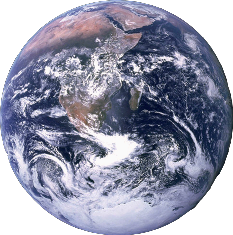
For more than six days Earth has been our friend in the lunar skies. That fragile piece of blue with its ancient rafts of life will continue to be man's home as he journeys ever farther in the solar system. Apollo 17, December 14, 1972
Showing posts with label atmosphere. Show all posts

Thursday, March 27, 2008

6. The Carbon Cycle - revolutionary industry

The picture so far....
describes the biological aspects of the carbon cycle. To recap, on the right hand side of the cycle, respiration in living cells releases the energy locked up in the carbon based molecules in a regulated and measured way. One byproduct is generally CO2, in turn produced in modest, measured quantities. There is a corresponding powerful chemical process which uses carbon and generates heat and carbon dioxide. In nature it generally takes place in an uncontrolled and fairly destructive fashion in the form of forest and heathland fires. If their scale is large enough they do have a short term impact on the atmosphere both from the smoke they cause and also the CO2 they generate. The counterbalancing forces do allow balance to return eventually. However, it is Man's continuing use of fire on a massive scale which is having a lasting and worrying effect on the biosphere. This takes two main forms: deliberate deforestation and the burning of fossil fuels. Both are important but it is the latter which is of greatest relevance to this stage in our investigation of the delicate biosphere which relies on a well-balanced carbon cycle.

The Industrial Economy
The quite extraordinary arising of the industrial economy over the last two centuries in the West and its spread to the East represents the biggest threat to the balance. In very general terms it would be true to say that the nineteenth century played host to the coal-fired industrial revolution and the twentieth supplemented coal with oil and natural gas. The inconceivably large amounts of CO2this produces, in comparison to the small regulated quantities needed to sustain biological life is pushing the carbon cycle out of balance - hence the level of CO2 in the atmosphere is not only rising but accelerating - this indicates that natural counterbalancing mechanisms are not working. The challenge for the 21st century is to bring control to the increasing CO2 levels and deal with the consequences of this increase in CO2 from our past and current actions and lifestyles.

Returning to the diagram, the additional arrow on the right hand side represents these new man-made chemical combustion processes which use fossil fuels to generate the goods, services and energy we demand. It also can include the energy required to fire the conversion of limestone to quicklime to make cement for the construction industry and its by product, carbon dioxide. The key point about the diagram is that there is no complementary arrow on the left hand side.

All the biosphere has to counteract these increased emissions are two factors of limited effectiveness.

  1. The first of these is increased activity on the left hand side of the cycle. It has been shown in the USA (Duke Forest Experiment) that plants can grow more quickly in the presence of higher concentrations of CO2 and thereby 'fix' more carbon. However this does not remain fixed for all that long and is likely to end up being decomposed or digested by other organisms in the biosphere. For example a conifer tree in a remote forest may grow for fifty years locking much of the carbon it fixes. However it will die and fall to the ground where it will be digested as food by insects, fungi and microorganisms which will expel the carbon as CO2 and methane.
  2. The second is natural sequestration enabled by organisms using carbon to produce skeletons containing calcium carbonate. Most typically this will be marine organisms with exoskeletons or shells. For example a mollusc builds a large shell over its lifespan and despite eventually dying or getting eaten the shell will remain chemically intact and will sink to the sea bed with its load of carbon. The carbon therein effectively has been removed from the biosphere - this is sequestration.

The next post looks more closely at the implications of digging up fossil fuels from the subterranean layer.

Read more!

5. The Carbon Cycle - the three spheres

Three spheres....
This diagram is split into three sections: the subterranean, the biosphere and the atmosphere. At this stage in the explanation, we can ignore the subterranean but we will return to it. The atmosphere extends 50 miles above the earth's surface - travellers beyond that limit are described by NASA as officially astronauts! The biosphere is minute in comparison and extends about 100 metres into the atmosphere and a few metres down into the subterranean. It is like a thin film spread across the surface of the earth and is immensely complex and extremely delicate. It is in constant movement supporting life from the scale of a single celled organism to a complex creature with 30 trillion cells, immeasurable numbers of which colonise this thin space. A curious 'world order' has kept this inconceivably complex layer of life reasonably harmonious.

The role of carbon....
Absolutely intrinsic to life is the element carbon - it provides the structure and energy for virtually every living thing. For life to exist in this particular place in the universe it is the only element in the periodic table capable of doing the job.

The role of the carbon cycle....
The diagram is describing the equilibrium between atmospheric carbon dioxide and 'fixed carbon' in the biosphere - these two forms of carbon are in constant exchange. The cycle turns anticlockwise. As living beings, and occupiers of the biosphere we, along with virtually every other form of life, emit CO2 every time we breathe - this is depicted on the right handside of the diagram. CO2 remains in the atmosphere until plant life ensnares it during the process of photosynthesis, which with the aid of sunlight, chlorophyll and water, turns it into energy-rich carbohydrate and pure oxygen. The oxygen is returned to the atmosphere and the carbohydrate enters the food chain to support virtually all living beings. This is depicted by the left hand side of the diagram. As stated in an earlier post, the carbon cycle is life's provider. Not only does it provide us all with nutriment it also restore the oxygen consumed in respiration to the atmosphere - within certain limits it maintains an equilibrium. In other words if one side of the cycle produces more CO2, then the other side will be induced to work harder to restore the balance. There are also large 'sinks' by which any ups and downs on either side of the cycle will be smoothed out - in much the same way a set of shock absorbers dampen the springiness of a car's springs.

The physical effect of CO2 in the atmosphere....
Unlike nitrogen and oxygen there is relatively little CO2 in the atmosphere - only every 2500th particle in the air is a CO2 molecule, and yet it has a major effect on our existence. Without it the planet would be uninhabitably cold, and in overdose it would be impossibly hot, like Venus. It has greenhouse gas properties which allow light radiation through from the sun but absorbs and retains the 'warm' infrared radiation from the earth's surface.
When I was born in the 1950's there were even fewer CO2 molecules - about one in every 3300 particles. In the last 50 years the concentration of CO2 in the atmosphere has increased by 30% and this is having many different types of impact on the biosphere. Unlike the carbon cycle most of these impacts do not have compensating counterbalances, and so the situation is tending to run out of control. The delicate biosphere is getting disrupted and could soon be beyond any possibility of self repair.

The next post will examine what is causing this rise in CO2.

(The chemists will have spotted a deliberate mistake on the slide - CxHy is not the generic formula for a carbohydrate. but bear with me, you'll see why I used it on the next post) Read more!