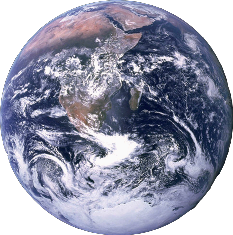
For more than six days Earth has been our friend in the lunar skies. That fragile piece of blue with its ancient rafts of life will continue to be man's home as he journeys ever farther in the solar system. Apollo 17, December 14, 1972
Showing posts with label earth. Show all posts

Saturday, April 19, 2008

7. The Carbon Cycle - how it can help our understanding


Natural CO2 emissions as part of a closed ecosystem.
The main product, along with CO2, from the right hand side of the cycle is energy. If we consider ourselves, Homo sapiens, 'being alive' means our bodies are respiring and producing energy. To do this carbohydrates are effectively being burned in a very regulated way. The energy produced keeps the body functioning, acting and moving. That's life. By living we therefore cause CO2 emissions - all six billion of us within the biosphere. The same applies to every other living being in the biosphere. CO2 emissions are therefore an inevitable consequence of life. However the carbon cycle makes good use of the CO2 as we have discussed previously and maintains an equilibrium. It has worked well as a 'closed ecosystem' - an ecosystem that can regulate itself.

Extra-ordinary emissions in an inflating closed ecosystem
The increasing activity of our increasing population is challenging this closed and self regulating equilibrium. Our population is expanding at 200,000 per day; on top of this our increasing activity requires more energy and raw material consumption per capita. Let's take this issue in two parts:
  1. A human community with an increasing population can continue to grow as long as it has a food supply and has a means of dealing with its waste. (This is leaving to one side the other biological and sociological needs such as a place to breed, room to function and some form of governance.) Both of the food supply and the waste treatment require complementary communities of organisms living within the ecosystem being sufficiently active to keep the ecosystem in balance. Left to Nature, once these complementary activities fail to keep up the population growth will be restrained by starvation or pollution - both these are tough options and immensely challenging for the leaders of a human community.
  2. Even a static human community with an increasing activity level consumes more energy and raw materials and produces more waste. In our search for ever greater well-being this is exactly what is happening in the West. Again this only remains sustainable if the complementary communities of other organisms, through the carbon cycle, can become more industrious and keep providing us with the food, raw materials and energy to give us the goods and services we desire, as well as dealing with the waste we are producing.
Faced with these two forces, increasing population and the desire for greater well-being through increased consumption, the highly resourceful human race has spent the last two centuries exploiting non-biological means to generate the energy we need - we have been digging up fossil fuels, which contain carbon from outside today's biosphere. The biosphere therefore is no longer an entirely closed system. There is carbon being introduced with no complementary process for getting it out of the system. It is introduced as dense, tangible and measurable fossil fuels but is converted into an invisible and elusive waste problem - carbon dioxide. The fact that the level of CO2 is rising in the atmosphere is clear evidence that neither we nor nature is coping with this waste stream.

What is the carbon cycle suggesting we can do?
There are four new features on the carbon cycle diagram - three sets of orange dots reflecting where the regulation of carbon consumption could be applied and a green arrow depicting a shift from the biological process to the chemical process.

  1. Changing the masses.
    The upper set of orange dots on the biological and chemical processes. These represent each of the 6 billion human carbon emitters, with 200,000 more each day - from people at only subsistence living through to powerful large consumers, such as most of the western world. Pretend you are the Prime Minister. How difficult do you think it would be for you to stop emitting so much? How easy would it be to persuade your children to reduce? How easy would it be to make your friends and neighbours reduce? How easy would it be to make your constituents change their habits? How easy would it be to change the habits of your country? How easy would it be for your close allies to change? How easy would it be for your past and present enemies to go with you on an emissions reduction campaign? And how easy would it be to persuade a subsistence farmer not to have the level of well-being we have in the West? Looked at this way most people would think this approach is nearly impossible and yet this is what the West is attempting to do. I think there is a novel glimmer of hope and I will return to this in a later post.
  2. Changing the many.
    A set of three orange dots on the chemical process. This represents the big 'institutional' consumers of fossil fuels - the utilities, heavy industry, transport and so on. At least there is a finite number of these, they are organisations, they can be spoken to, they are regulated to some extent. If there were a global need to apply restraint it would easier to achieve using this option. There is currently considerable hope for carbon dioxide capture at these points but I think there are major drawbacks and limitations for this approach but we have been investigating other ways of reducing carbon consumption and CO2 emissions in this area by looking again at the old technologies of wood gas and charcoal production. This will be dealt with in a later post.
  3. Changing the few.
    An orange dot on the arrow depicting fossil fuel extraction from the subterranean. There are definitely a finite number of coal mines, oil-fields and gas rigs, run by a small number of energy companies and these are large and visible sites. Yes, they are powerful now, but for how long? Yes, their interests need to be respected. If you were Secretary General of the UN, with an urgent mandate to reduce emissions, where would you start - at 1,2 or 3?

  4. Making the most of our emissions.
    The green arrow depicting a shift from the biological process to the chemical process. At first sight this may appear counter-intuitive - you would probably consider me mad to suggest that you should burn your compost heap rather than let it moulder away. However this choice needs looking at carefully in the context of the diagram. A well managed compost heap takes biomass and produces mulch, carbon dioxide and heat. The heat is not made use of, other than to accelerate composting, so your mulch has caused CO2 emissions. If that same biomass was naturally dried and then effectively incinerated or processed into fuel, then mankind debatably would gain more benefit from your compost.
    There are considerable efforts going into processing biomass, specifically grown for bio-fuel.
    There is less but very interesting research into how to process large scale agricultural waste biomass into fuel.
    There are also valuable initiatives to rid landfill sites of biomass. In a landfill site biomass does not produce usable compost but produces methane which is a greenhouse gas of fifty times more power than CO2.

To summarise the argument, thus far, we will return to the Framework Diagram from post 4.

The biosphere
Life on earth takes place in a delicate and isolated ecosystem called the biosphere which relies entirely upon the unique chemistry of carbon. This biosphere is no more than a film on a tiny planet and extremely delicate. It is in constant movement and supports various cyclical processes which are highly balanced and interrelated.
The carbon cycle and the energy cycle
The carbon cycle is life's provider and the framework puts a renewed understanding of the carbon cycle at its very centre. Mankind needs sources of energy to exist and to be well (well-being) In its recent proliferation and increased activity levels it has found carbon-bearing fuel outside the biosphere to meet its energy needs. In burning these fuels the carbon cycle is no longer in balance. This is leading to the biosphere increasing in overall temperature due to the greenhouse effect. By understanding the carbon cycle it is possible to evaluate which measures are likely to be the most efficacious.
Economics and Politics, Philosophy and Moral Values
The ownership of energy production bestows enormous power on the few - however this situation can be seen as potentially our saviour. The framework finally recognises that all this energy fuelled activity is dedicated to what we really want - our desires and aspirations and what we are prepared to sacrifice.

The next two posts look at some secondary threats to the carbon cycle involving oceanography, climate science and demographics. That will then complete the initial analysis and from this a framework for effective action will be proposed which will draw upon, in part, the findings we discovered along the way.


Read more!

Sunday, March 23, 2008

2. A brief history - through my eyes.

This is a sporadic history....
of the last two years which started considering 'global warming' at quite a challenging time. There seemed little consensus on whether there was even a problem.
On the one hand, those who believed there was looked like amateur doom mongers and many scientists were sceptical and dismissive. On the other hand, politicians at all levels of government were 'going green' but this was not in specific response to global warming which, at that stage,
was a relatively new thing. It was more a result of a vociferous and longstanding general environmental lobby.

The initial step.....
was quite daunting. I could not answer simple questions like:


  • what do we mean by a global climate?
  • what do we mean by it changing?
  • how could we measure any such change?

I needed help. I was very fortunate in having many acquaintances who could provide some pointers and we happened to be on a week long philosophical retreat together in May 2006. Most of what will follow in subsequent blogs will still be based upon those initial discussions and suggested lines of enquiry. The most compelling outcome of this was that Man had to stop digging up fossil fuels - not before they ran out - but before we seriously disturbed the small and delicate levels of CO2 and other more powerful greenhouse gases in the atmosphere. Even my O-level understanding of the carbon cycle made this clear to us. This did not appear to be clearly enunciated in the world at the time. You will hear a lot more from me on the difference between 'emissions' and 'extraction' (also described as 'stop digging') in later posts. This is a most unpalatable message to the economic world and therefore probably impossible, which continued to niggle for me. Some recent ideas of ours have suggested a new angle on this, which I'll be posting up in due course.

And subsequently....
as time has gone by, the disciplines listed on the left hand side of the slide have needed to be employed.

First early conclusion....
well, if there is a man-made problem, then there sure is no effective global leadership on it. Everyone's opinion is as god(sic) as the next. In June 2006 I confronted a 'Friends of the Earth' rep on my doorstep on whether they had a consolidated view on what the truth of the matter was. In the end he resorted to saying that as long as we all do something, it's better than nothing - I was shocked. I immediately visited their web-site and then felt very sorry for the guy - there was no definition of the problem, let alone a coherent response. I also concluded that my early curiosity was not going to be easily satisfied and I had better carry on.

Second conclusion....
By August 2006, I had blagged my way into speaking on Climate Change to a group of amateur economists from across the globe on a similar retreat, to the one I was on in May. I hastily put together a presentation and laced it with pictures of polar bears, melting icebergs and ice retreat. Whilst some of the ideas were reasonable to the audience I got marmolised for using 'factoids' and having a very blinkered understanding of deforestation in Africa and Brazil. I concluded that I had to be far more careful to work from original thought and research each point as best I could. This was an important lesson to learn, for which I remain grateful, as I do to all the people I pepper questions at.

The more recent history....
Al Gore's film (and book, which I bought the day after), "An Inconvenient Truth", Sarah and I saw early, before most of our friends in Autumn of 2006. I was struck by the persuasiveness of his brilliant displays and oratory and thought that this was a powerful force for good.
On getting the book I was disappointed by the paucity of ideas about how to solve the problems so beautifully depicted. Less than 10% of the pages at the back of the book were devoted to a mish mash of ideas, very much like the aforementioned Friends of the Earth. Sorry, Mr Gore, but the other 90% has done a great job in waking up the world to the problem.

James Lovelock and Gaia....
In January 2007 we heard James Lovelock being questioned by Claire Gilbert, and old acquaintance and leading thinker in the Church of England, in St Paul's Cathedral. My main memory of that occasion was his reluctant acceptance that nuclear power was a large part of the solution, being the lesser of two evils. I was both depressed and excited. A partial solution, at best, from a combination of a wise man and the Church - was this the best they could come up with?

More confusion....
Channel 4's programme in Spring 2007 which persuaded a large number of my associates that the crisis was not man-made and therefore was little effect from moderating our behaviour on the planet. Note to ed: I must watch my DVD of this.

Stern words....
for the world from Sir Nicholas Stern in his Stern Review in Summer 2007. He basically gave credence to the widening view that climate change (CC from now onwards) was inevitable and would have large scale consequences, but that if we acted now its cost to the global economy seemed quite palatable in comparison to the predictions of even quite optimistic models.

Next speaking occasion....
was lined up for August 2007 in London. I had to hedge my bets on whether Al Gore was right and C4 were wrong by ignoring the question and stating in my advertising that 'irrespective of whether it was a man-made phenomenon or not was there not an opportunity for mankind?' That, along with the 'Kyoto Protocol' being effectively dead meant there was merit in starting to look at what might both make mankind happier and make it less ignorant of the effect of its excesses. The 'stop digging' message also seemed to be quite a good wake up call for the audience.

A sagacious science teacher in the American mid-west....
in October 2007 solved the "is it; isn't it" debate for me and many others, as to whether climate change is the result of man-made action or not. He put a 'global risk management hat' on and quickly concluded that the only reasonable course was to stop debating whether the cause of CC was Man or not and to act decisively to mitigate its effects. This was the best use of a 'Boston Matrix' I had ever seen. You'll find his arguments beautifully explained at http://www.wonderingmind42.com/. I will be devoting a post on this shortly.

Still no real solutions though....
despite the Bali roadmap and Al Gore receiving his Nobel Prize in December 2007. Our work on the framework was developing it further and it is around Feb 2008 that some of the disciplines on the left hand side of the screen started to become important. That's about it for now on this post.

I do look forward to your comments.

Oh - and those curious icons across the top of the slide? - there is one of those for each big topic to follow in subsequent posts.

And so to my next post, which will be shorter, I promise...............................................

Read more!